
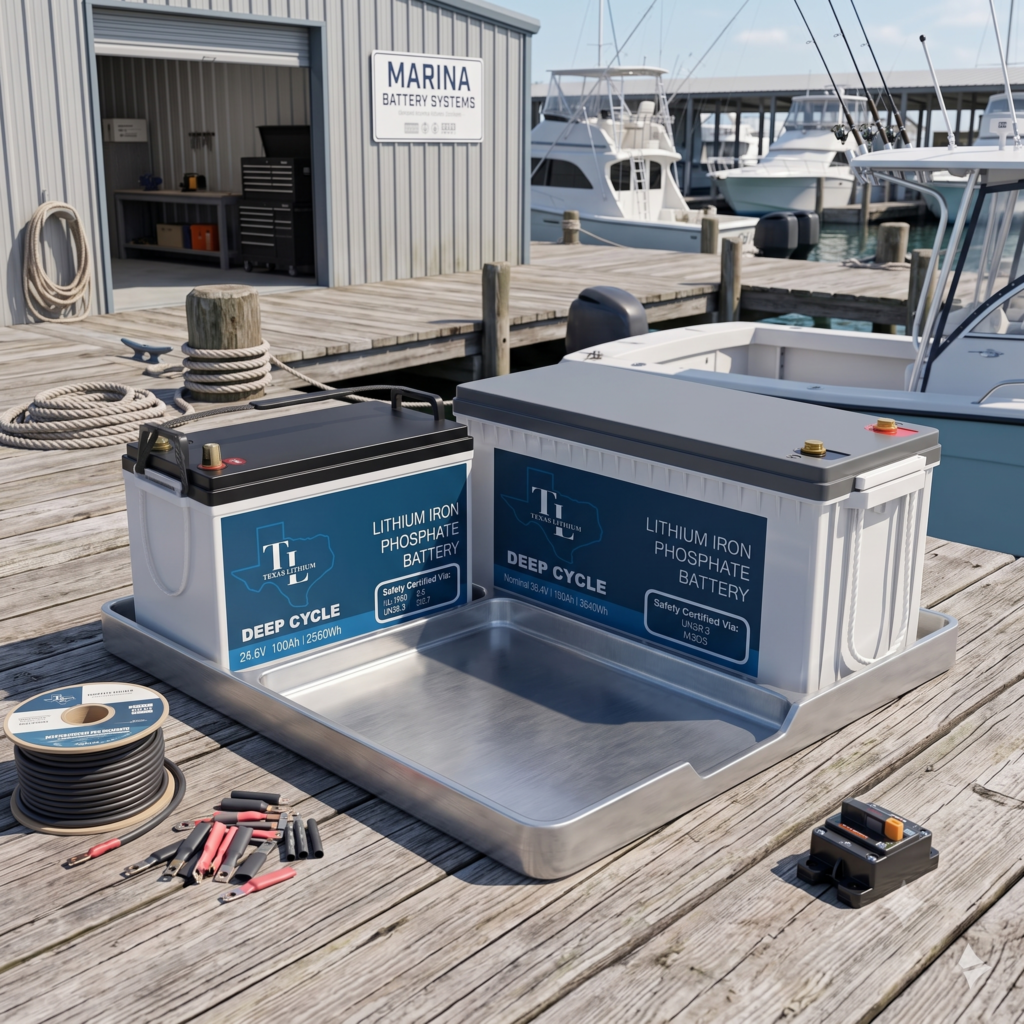
24V Trolling Motor Battery
A trolling motor battery earns its keep when the wind comes up, the fish move farther down the bank, and heading back early is not an option. The best 24v trolling motor battery is not simply the one with the biggest amp-hour number on the label. It is the battery system that can supply your motor’s current demand, fit your boat safely, recharge on your schedule, and hold up through years of real deep-cycle use.
For many anglers, that points to a properly matched LiFePO4 battery setup. Lithium iron phosphate batteries cut a major amount of weight from the boat, charge faster than lead-acid, and deliver usable voltage more consistently through the day. Still, capacity, wiring, charger compatibility, and the battery management system all matter. Here is how to choose with your boat and fishing style in mind.
What Makes the Best 24V Trolling Motor Battery?
A 24-volt trolling motor needs a true 24-volt battery bank. Traditionally, that means two matching 12V deep-cycle batteries wired in series. The voltage doubles from 12V to 24V, while amp-hour capacity remains the same. Two 12V 100Ah batteries in series create a 24V 100Ah bank, not a 24V 200Ah bank.
You can also run a dedicated 24V LiFePO4 battery. This approach reduces connections, simplifies installation, and can make troubleshooting easier. Whether you choose two 12V batteries or one 24V battery, the system should be designed for the motor’s maximum current draw and the amount of time you actually spend on the water.
The best choice comes down to four working factors: usable energy, discharge capability, physical weight and fit, and charging equipment. A battery can look good on paper yet be a poor match if its BMS cannot support the motor’s demand or if your onboard charger is not compatible with lithium charging requirements.
Start With Watt-Hours, Not Just Amp-Hours
Amp-hours are useful, but watt-hours provide a clearer comparison because they account for voltage. A 24V 100Ah LiFePO4 battery stores roughly 2,560 watt-hours of energy using its typical 25.6V nominal voltage. That is a meaningful amount of reserve for a 24V trolling motor.
A simple runtime estimate looks like this:
Battery watt-hours ÷ motor watts = estimated runtime in hours
If your motor is drawing 1,200 watts at a particular speed, a 2,560Wh battery may provide a little over two hours at that load under favorable conditions. Real-world runtime changes with wind, current, boat weight, prop condition, weeds, battery temperature, and how often you run at high speed.
The key point is that trolling motors are rarely operated at full throttle all day. An angler working shorelines, docks, or a brush pile may run at low to moderate power much of the time. That is why a 24V 100Ah LiFePO4 battery is a practical starting point for many bass boats, aluminum fishing boats, and bay boats. Serious tournament use, large hulls, strong current, or long days on big water may justify a parallel system made up of two or three 24V 100Ah LiFePO4 batteries.
Choose Capacity for How You Fish
There is no honest one-size-fits-all battery recommendation. A weekend angler fishing protected lakes for four or five hours has a different power need than a tournament crew fighting wind across an open reservoir.
A 24V 50Ah LiFePO4 setup can work well for smaller boats, short trips, and low-draw use. It provides a substantial improvement over a compact lead-acid bank because lithium maintains voltage well and offers more usable stored energy. But it does not leave much reserve for a hard day of wind, spot-lock style anchoring, or frequent high-speed repositioning.
A 24V 100Ah system is the practical middle ground for many boat owners. It offers strong all-day capability without taking up excessive space or adding unnecessary cost. For anglers who want to launch at daylight and stay out until the bite is done, this is often the capacity worth buying first.
Ensure to carry a bank of 24V 100Ah batteries for long tournament days, larger boats, demanding waters, and owners who would rather carry reserve than watch a battery gauge. Extra capacity also helps if the battery bank supports other approved 24V accessories. Just make sure the added battery size fits the compartment and does not create cable-routing headaches.
LiFePO4 vs. Lead-Acid on a 24V Boat
Lead-acid deep-cycle batteries have served boats for a long time, but they ask for compromises that many anglers no longer need to make. They are heavy, their available power falls as they discharge, and repeated deep discharge shortens their service life. Flooded batteries also require maintenance and proper venting.
LiFePO4 batteries are lighter, maintenance-free, and capable of far more charge and discharge cycles when used within their specifications. Their voltage stays steadier under load, which helps a trolling motor perform consistently as the day wears on. A lithium bank can also charge much faster when paired with the right charger and adequate shore power.
Weight reduction is not a small detail. Replacing a pair of heavy lead-acid batteries can remove well over 100 pounds from the stern or forward battery compartment, depending on the old setup. That can improve trailer handling, boat trim, and how much work it takes to load the rig at the end of a long day.
Lithium is not magic, though. It requires proper charging and cold-weather awareness. LiFePO4 batteries generally should not be charged below freezing unless the battery has a built-in low-temperature charging protection system or internal heating designed for that purpose. If your boat is stored outdoors through a northern winter, this needs to be part of the plan.
Check BMS and Motor Draw Before You Buy
The battery management system, or BMS, is the protective control center inside a lithium battery. It monitors cells and protects against conditions such as overcharge, over-discharge, short circuit, and excessive current. For trolling motor use, the continuous discharge rating matters just as much as the amp-hour rating.
Look up your motor’s maximum amp draw in its manual, then select a battery or battery bank with a BMS continuous discharge capability that exceeds that number with room to spare. Do not assume that every lithium battery marketed as “deep cycle” is suitable for high-demand marine propulsion loads.
If you use two 12V batteries in series, use matching batteries of the same chemistry, capacity, age, and state of charge. Mixing an old battery with a new one, or pairing different capacities, creates an imbalance that can shorten battery life and cause avoidable BMS shutdowns.
Wiring a 24V Bank Correctly
Series wiring is straightforward, but it must be done carefully. Connect the positive terminal of the first 12V battery to the negative terminal of the second battery. The open negative terminal on the first battery becomes the system negative, and the open positive terminal on the second becomes the system positive for your trolling motor.
Use appropriately sized marine-grade cable, clean terminals, secure battery trays, and the fuse or circuit protection required by the motor manufacturer. Loose connections create heat, voltage drop, and trouble at the worst possible time. A battery upgrade is also a good time to inspect corroded lugs, worn cables, and undersized wiring left over from an older setup.
A single dedicated 24V battery eliminates the series jumper, but it still needs correct cable size, secure mounting, and overcurrent protection. Simpler is good, provided the battery is sized for the job.
Do Not Overlook the Charger
A battery system only performs as well as it is charged. Confirm that your onboard charger has a lithium charging profile or is approved by the battery manufacturer for LiFePO4 use. Some older lead-acid chargers use desulfation or equalization modes that are not appropriate for lithium batteries.
For a pair of 12V lithium batteries in series, a two-bank 12V lithium-compatible charger is often the cleanest solution because each battery is charged and monitored individually. A dedicated 24V battery typically uses a 24V lithium-compatible charger. Follow the battery manufacturer’s recommended charging voltage and current rather than guessing.
Fast charging is one of lithium’s biggest ownership advantages, but charging current should still be sensible for the battery capacity and your available power source. A larger charger can shorten turnaround time, yet it will not make a poor shore-power connection or undersized extension cord perform better.
Buy for the Water You Actually Run
The right battery is not the cheapest model that starts the motor at the dock. It is the one that still gives you control after a full day of wind, current, and repeated positioning. Match capacity to your longest typical trip, select a BMS that can carry your motor’s load, and use a charger built for LiFePO4 chemistry.
For anglers ready to leave heavy, fading lead-acid batteries behind, a properly sized lithium system is a practical upgrade that pays back every time the boat stays light, the motor stays strong, and the day lasts as long as you planned. Texas Lithium Batteries approaches that job the same way a good boat owner does: get the specifications right before you leave the ramp.