
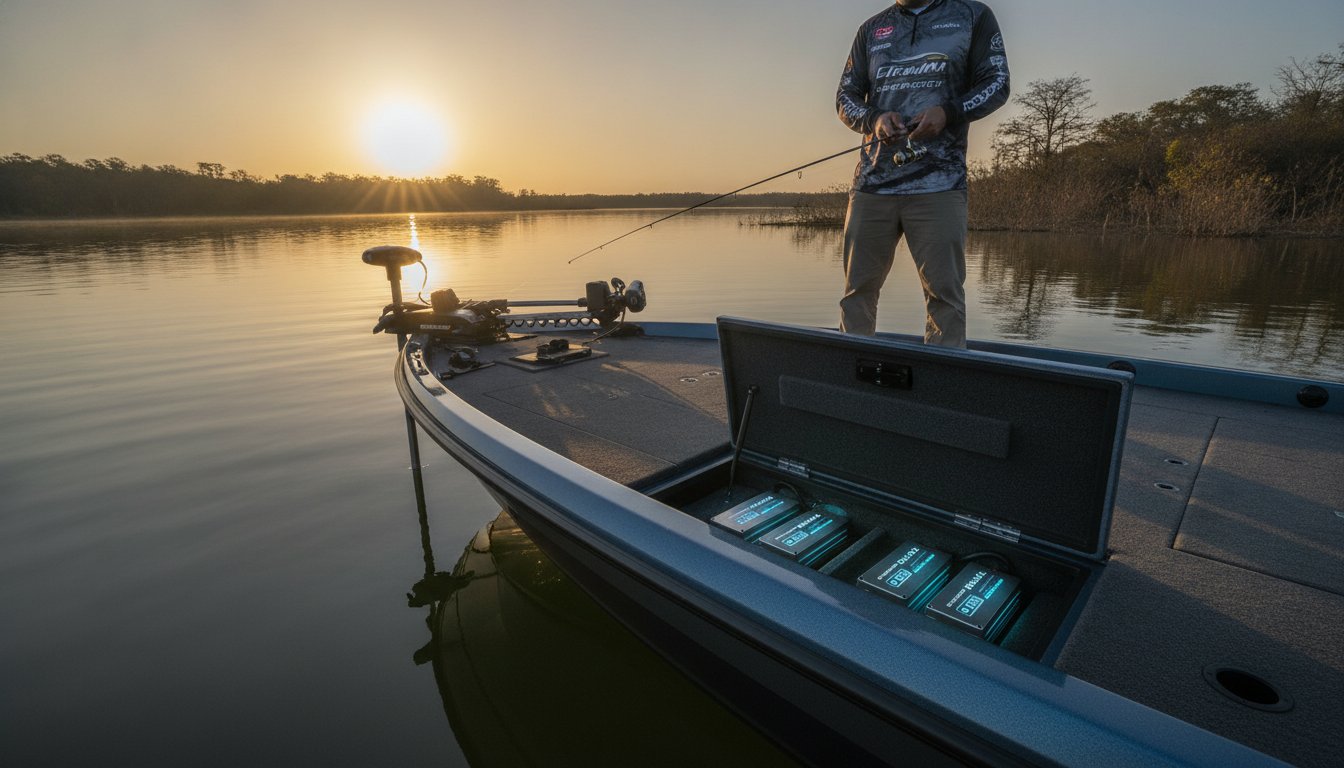
You are five miles offshore when your trolling motor starts to stutter. The Texas heat is relentless. Your heavy lead-acid batteries are already hitting a voltage floor. It’s a scenario that ruins tournaments and ends weekends early. You shouldn’t have to fight your equipment while you’re trying to fish. Reliable power is a necessity, not a luxury, when you’re miles from the dock.
Finding the best battery for trolling motor performance means moving beyond outdated technology. We’ll help you eliminate dead weight and discover the high-performance lithium solutions that keep you on the water longer. You need a battery that lasts 10 years and sheds 70% of the bulk from your hull. This is about more than just convenience. It’s about meeting the strict 2026 USCG safety standards and ABYC E-13 requirements for LiFePO4 systems. We’ll preview the top 24V and 36V American-made picks and the technical upgrades like Class T fuses that your rig requires to stay legal and powerful.
Key Takeaways
- Stop fighting voltage sag and heavy lead-acid batteries that die early. Switch to LiFePO4 for consistent power.
- Learn why 100Ah is the sweet spot for the best battery for trolling motor performance in 24V and 36V systems.
- Shed up to 70% of battery weight to immediately improve boat speed and shallow-water draft.
- Protect your investment with high-grade BMS technology designed to handle extreme Texas heat and coastal saltwater.
- Transition your rig with a simple two-step plan to ensure mission-ready reliability for the next 10 years.
Why Your Trolling Motor Battery Is the Weakest Link
Traditional lead-acid batteries are obsolete. They are literal dead weight. Most anglers treat them as a budget-friendly choice, but they are the single biggest point of failure on a modern boat. When you rely on 19th-century technology to power a 21st-century GPS-anchored motor, you invite trouble. You’re forcing your gear to work harder with less efficiency.
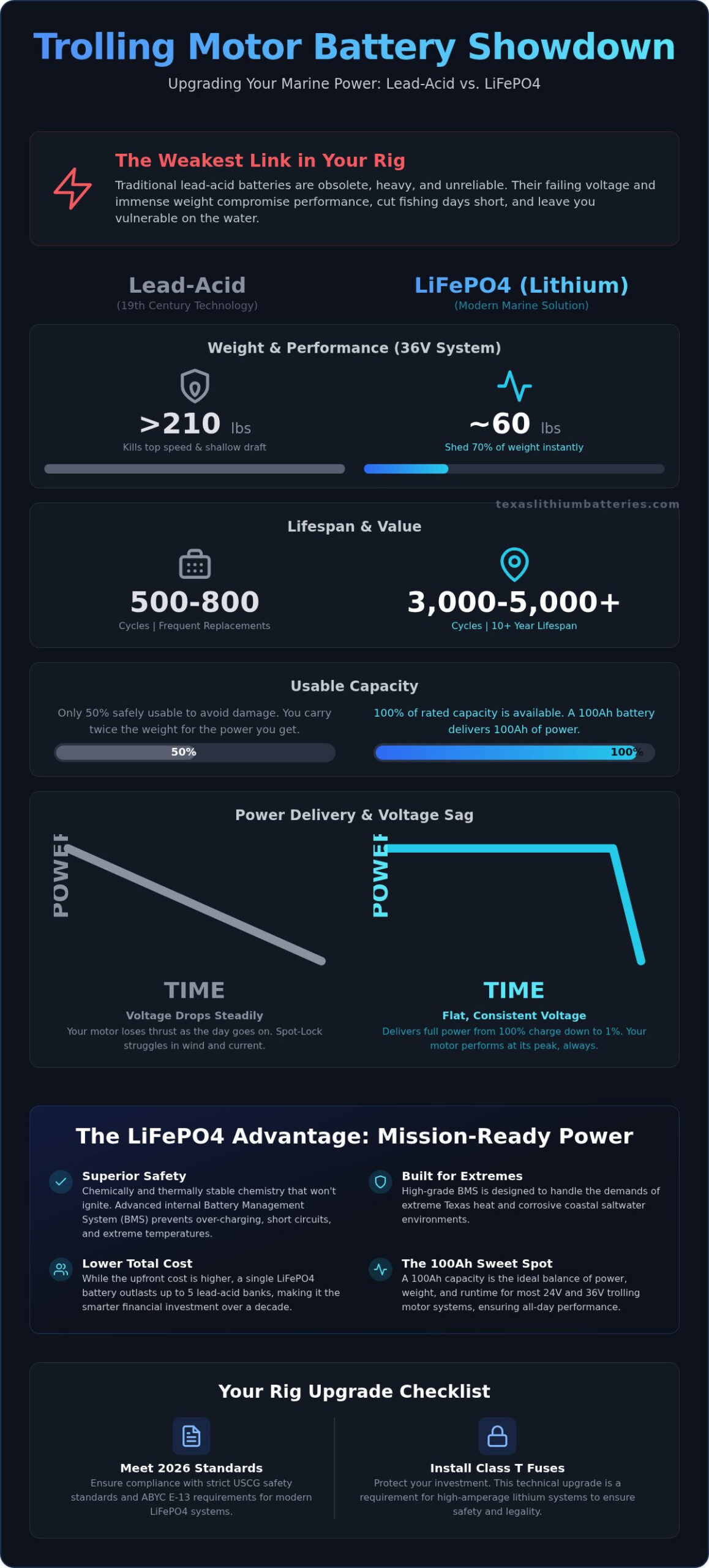
Voltage sag is the silent killer of fishing trips. As the day progresses, lead-acid voltage drops steadily. Your 36V motor starts acting like a 24V system. You lose thrust exactly when the wind picks up or the tide turns. This isn’t just an inconvenience; it’s a performance failure that leaves you struggling against the elements. Lithium doesn’t have this problem. It maintains a flat voltage curve until the battery is nearly empty.
Then there is the weight penalty. A typical three-battery lead-acid bank for a 36V system can exceed 210 pounds. That mass sits in your hull, ruining your boat’s draft and killing your top-end speed. You’re burning more fuel and struggling in shallow water just to carry your power source. It makes no sense to spend thousands on a lightweight hull only to clutter it with lead.
The True Cost of Cheap Marine Batteries
Don’t be fooled by a low sticker price. Standard deep-cycle batteries are rated for only 500 to 800 cycles. Even worse, you can only safely use 50% of their capacity. If you discharge them further, you’re causing permanent internal damage. You’re essentially buying half the power you’re carrying.
Finding the best battery for trolling motor use means looking at the total cost of ownership over a decade. High-performance lithium batteries offer 3,000 to 5,000 cycles. You’ll replace your lead-acid bank five times before a single lithium unit breaks a sweat. Because you can use 100% of the rated capacity without damage, a single lithium battery often does the work of two lead-acid units. The math favors lithium every time.
Vulnerability vs. Readiness on the Water
Equipment failure is a choice. If you hit the water with corroded terminals and leaking acid, you aren’t prepared. You’re vulnerable. A field-ready power solution eliminates the anxiety of a dying motor. You need to know that your Spot-Lock will hold in a heavy current at the end of the day. Investing in the best battery for trolling motor reliability is about more than gear; it’s about the security of knowing your equipment won’t quit before you do. Stop managing your batteries and start managing your fishing.
The LiFePO4 Advantage: Superior Science for Marine Power
LiFePO4 stands for Lithium Iron Phosphate. It isn’t just a buzzword. It’s the only chemistry you should trust in your hull. Unlike lead-acid, it delivers consistent power throughout the entire discharge cycle. Your motor gets the same thrust at 10% charge as it does at 100%. This steady output is why serious anglers consider it the best battery for trolling motor setups. You don’t have to worry about your Spot-Lock failing as the sun goes down. The science ensures your motor performs at peak efficiency from the first cast to the last.
The longevity of this chemistry is unmatched. Traditional batteries are prone to sulfation and internal degradation, often failing after just 300 to 500 cycles. LiFePO4 batteries are rated for 3,000 to 5,000+ charges. You could fish every single day for ten years and still have plenty of life left in the cells. This durability makes lithium a one-time investment rather than a recurring expense. You stop being a customer of the battery shop and start being a master of your own power.
Safety First: Why Chemistry Matters
LiFePO4 is the most stable lithium chemistry available for marine use in 2026. Standard lithium-ion batteries (NMC) found in consumer electronics carry a risk of thermal runaway. They can catch fire if punctured or overheated. LiFePO4 is different. It is chemically inert and thermally stable. Even under extreme stress or high vibration, it won’t ignite. This is the gold standard for marine safety.
The internal Battery Management System (BMS) acts as a digital sentry. It monitors voltage, current, and temperature in real-time. If conditions become unsafe, the BMS shuts the system down instantly to prevent damage. This level of protection is why organizations like the Navy Lithium Battery Safety Program emphasize rigorous management and safety standards for high-energy systems. You aren’t just buying power; you’re buying security for your vessel and your crew.
Weight Reduction and Hull Performance
Lead is heavy and inefficient. A 36V lead-acid bank usually requires three separate 12V batteries weighing 60 to 70 pounds each. That’s over 200 pounds concentrated in your battery compartment. A single 36V lithium unit weighs roughly 60 pounds total. You’re shedding 150 pounds of dead weight instantly. This reduction transforms your boat’s handling characteristics.
You’ll see higher top speeds and a shallower draft. It allows you to get into the skinny water where the fish are hiding. Plus, you gain significant storage space. Instead of a cramped, acid-stained compartment, you have room for extra gear or a secondary backup system. Reliability matters when you’re miles from the ramp. Our American-made lithium batteries provide the cycle life and weight savings you need to stay mission-ready for a decade.
Best Batteries for Trolling Motors: 2026 Roundup
Choosing the best battery for trolling motor performance requires matching your system voltage to your specific mission requirements. For 2026, the 100Ah capacity has emerged as the definitive industry standard for full-day reliability. It provides the necessary reserve for high-thrust operation without the risk of early depletion. Whether you are running a 24V or 36V system, a single-unit lithium solution is the only way to ensure your rig is truly field-ready. Stop compromising your boat’s performance with rigged-up series connections.
The 36V Powerhouse for Tournament Anglers
The Texas Lithium 36V 100Ah Trolling Motor Battery is the ultimate solution for professional setups. If you are piloting a heavy fiberglass bass boat or a multi-species rig in heavy current, you need this level of sustained power. Wiring three 12V batteries in series is a liability. It creates multiple points of failure. Every connection is a potential resistance point or corrosion risk. A single 36V unit eliminates these vulnerabilities and streamlines your entire power compartment.
This American-made LiFePO4 battery is engineered for the rigors of tournament life. It provides the high short-circuit current capability required to comply with ABYC E-11 safety standards. When you pair this unit with a mandatory Class T fuse, you achieve the highest level of electrical protection available in 2026. You get 100% usable capacity and a flat voltage curve that keeps your motor at maximum thrust until the final cast. It is the definitive choice for anglers who refuse to let equipment failure dictate their success.
The 24V Solution for Versatile Performance
For mid-sized boats and aluminum rigs, the Texas Lithium 24V 100Ah Trolling Motor Battery offers the perfect balance of power and weight reduction. Many anglers struggle with the weight of traditional 24V setups, which often tilt the boat or increase the draft. Switching to a single 24V lithium unit sheds significant bulk while doubling your usable run time compared to lead-acid alternatives. You gain speed and agility without sacrificing the power needed to hold your position in the wind.
Installation is direct and simplified. You remove two heavy lead-acid batteries and replace them with one lightweight, high-performance unit. This setup is ideal for coastal fishing near Corpus Christi or Port Isabel where maneuverability in shallow water is critical. It ensures you have the power to combat coastal tides without the draft-killing weight of lead. This is the best battery for trolling motor systems where efficiency and shallow-water access are the top priorities. You stay mission-ready, regardless of the conditions.
Texas-Proofing Your Marine Power System
Texas waterways present a unique set of challenges that standard equipment cannot handle. If your gear survives a mid-August afternoon on Lake Travis or a week in the high-salinity air of the Laguna Madre, it is built correctly. Finding the best battery for trolling motor performance in this region requires hardware designed for thermal stress and constant vibration. You need a system that prioritizes heat dissipation and corrosion-proof seals to maintain your state of readiness.
Surviving the Texas Heat
Ambient temperatures in San Antonio, Dallas, or Lubbock regularly spike above 100 degrees. Inside a closed battery compartment, those temperatures can climb much higher, threatening the stability of lesser cells. High-quality LiFePO4 is essential because it maintains performance even when ambient temperatures exceed 100 degrees. While lead-acid batteries suffer internal plate damage and fluid loss in these conditions, lithium remains stable and efficient.
Proper ventilation is your first line of defense. We recommend installing passive vents or small solar fans to circulate air through your battery compartment. This simple step can reduce internal heat by 15 to 20 degrees, preventing the BMS from triggering a thermal shutdown. You want your power available when the bite is on, not sidelined by a safety circuit because your compartment reached critical temps. Reliability is built on the environment you provide for your power source.
Coastal Durability and Corrosion Resistance
Coastal fishing in Corpus Christi or Port Isabel is notoriously brutal on electrical systems. Saltwater humidity acts as an electrolyte, accelerating corrosion on every exposed terminal. You need a battery with a fully sealed case and high-grade internal components to survive the brine. Rugged housing is non-negotiable for boats operating near McAllen or Mission. It keeps the salt out and the power in, making it the best battery for trolling motor applications in coastal marshes.
Apply a thin layer of dielectric grease to your terminals to provide an extra barrier against the salt air. Our batteries feature vibration-resistant internal architecture to handle the chop of the open bay. You shouldn’t have to worry about a loose cell connection when you’re five miles from the ramp. For the ultimate in local reliability and American-made quality, shop our specialized marine lithium batteries and stay mission-ready regardless of the conditions.
Reliability is about more than just hardware; it’s about the support behind the product. When you buy from Texas Lithium Batteries, you are investing in local expertise and accountability. If you have a technical question or a warranty claim, you aren’t calling an overseas center. You are talking to professionals who understand the specific demands of Texas waters. This local presence ensures you spend more time fishing and less time waiting for support, providing the final piece of the preparedness puzzle.
Get Ready: How to Switch to Lithium Today
Upgrading your power system is a tactical improvement that demands precision. You aren’t just swapping a battery; you’re modernizing your boat’s entire electrical foundation. A successful transition ensures your rig is mission-ready for years of service. Follow this roadmap to select the best battery for trolling motor performance without compromising your motor’s electronics. A methodical installation protects your investment and ensures maximum thrust on demand.
Step 1: Identify your motor’s voltage. Most high-thrust systems operate on 24V or 36V. Check the serial plate on the motor bracket or the owner’s manual. Supplying the wrong voltage will destroy the control board instantly. Precision in voltage matching is the first rule of marine electrical safety.
Step 2: Verify your capacity needs. For 2026, 100Ah is the standard for professional reliability. It provides the necessary reserve for a full day of heavy operation in wind or current. This capacity offers the ideal balance between weight reduction and endurance. It ensures you have the power to stay on the fish until the final cast.
Step 3: Audit your charging system. Lithium requires a specific charging algorithm. You must ensure your charger has a dedicated LiFePO4 profile to protect the internal cells and the BMS. Using the wrong profile is a common cause of premature system failure.
Step 4: Secure the installation. Lithium batteries are significantly lighter than lead-acid. They can shift in trays designed for heavier, bulkier batteries. Use dedicated mounting brackets or spacers to prevent movement during rough runs across the lake. High vibration is a threat to any electrical connection.
Charging Your Lithium Investment
Your charger must be set to a “Lithium” or “LiFePO4” profile. Using an old lead-acid charger is a mistake that can lead to permanent damage. Traditional chargers often use an “equalization” or “desulfation” mode that sends high-voltage pulses into the battery. These spikes can trigger a safety shutdown in the BMS or degrade the cells. Verify that your charger matches the system voltage. A 36V system requires a 36V charger. Do not attempt to charge a single-unit lithium battery with multiple 12V chargers unless the manufacturer specifically approves the wiring configuration. Charging safety is paramount for long-term reliability.
Secure Your Power Now
Don’t wait for your current batteries to leave you stranded. Transitioning to a high-performance system provides the peace of mind that comes from total preparedness. You get a decade of reliable service and a boat that handles better in every condition. If you want the best battery for trolling motor use, you need a solution built for the demands of serious anglers. Take control of your power today. Consult the Texas Lithium Batteries preparedness guide for total power security. Shop Texas Lithium Trolling Motor Batteries and ensure your next trip is defined by your catch, not your equipment failure.
Dominate the Water with Mission-Ready Power
Lead-acid batteries are a liability you can no longer afford. Transitioning to high-capacity LiFePO4 chemistry is the only way to ensure your rig is fully equipped for the challenges of 2026. You’ve seen how shedding 150 pounds of dead weight transforms your boat’s draft and top-end speed. You also know that American-made quality is the only defense against the brutal Texas heat. Reliable power isn’t a luxury; it’s the foundation of every successful trip.
Finding the best battery for trolling motor performance means choosing a solution that lasts 10 years and meets every safety standard. Don’t let a voltage drop dictate when your day ends. Our batteries provide the thermal stability and cycle life you need to stay on the water until the job is done. You deserve equipment that works as hard as you do.
Secure your boat with a Texas-made 36V Lithium Battery and receive our Free Preparedness Guide to ensure total power security. It’s time to stop managing your gear and start focusing on the fish. You are ready for whatever the water throws at you. Get back out there with confidence.
Frequently Asked Questions
Can I use a regular charger for a lithium trolling motor battery?
No. You must use a charger with a dedicated LiFePO4 profile. Standard lead-acid chargers often include a desulfation mode that uses high-voltage spikes. These pulses can permanently damage the internal Battery Management System (BMS) or cause a safety shutdown. Always verify charger compatibility before connecting your power source to avoid voiding your warranty.
How many years will a LiFePO4 trolling motor battery last?
A LiFePO4 battery will typically last 10 years or more. These units are rated for 3,000 to 5,000 charge cycles. In contrast, lead-acid batteries usually fail after 300 to 500 cycles. This long-term durability makes lithium a one-time investment for most boat owners. It ensures you stay prepared for a decade of fishing without the vulnerability of failing cells.
Is a single 36V battery better than three 12V batteries for my motor?
A single 36V battery is the more reliable choice. It reduces the number of cables and connection points in your battery compartment. Fewer connections mean less chance of corrosion or vibration-induced failure. It also saves significant space and simplifies your wiring, making your entire electrical system more efficient and easier to manage during field maintenance.
Will a lithium battery make my boat faster?
Yes. Lithium batteries are 50% to 70% lighter than lead-acid alternatives. When you choose the best battery for trolling motor performance, you can remove over 150 pounds of dead weight. This improves your boat’s hole shot, increases top-end speed, and allows you to navigate shallower water without dragging the bottom. You gain immediate performance advantages.
Are lithium batteries safe to use in saltwater environments?
Yes, lithium batteries are safe for saltwater if they feature sealed, rugged housing. Corrosion is the primary threat in coastal environments. You must protect the terminals with dielectric grease and ensure the battery is mounted securely. High-quality marine lithium units are built to withstand the heavy vibration and salt-heavy air found in coastal regions like Corpus Christi.
How long can I run my trolling motor on a 100Ah lithium battery?
A 100Ah lithium battery generally supports 8 to 10 hours of typical use. Because you can safely discharge 100% of the capacity, you get twice the usable power of a lead-acid battery. This capacity is the industry standard for anglers who need full-day reliability in varied wind and current conditions. It provides the reserve power required for total self-sufficiency.
Do lithium batteries lose power as they get closer to empty?
No. Lithium batteries provide consistent voltage from 100% down to roughly 5% charge. You won’t experience the “voltage sag” that causes lead-acid batteries to lose thrust as they drain. Your trolling motor will perform at maximum power until the very end of your trip, ensuring you stay in control regardless of the remaining charge level.
What happens if a lithium battery gets too hot in the Texas sun?
If internal temperatures become extreme, the BMS will shut the battery down to prevent damage. LiFePO4 is the most thermally stable lithium chemistry available, but it still requires ventilation. In the Texas heat, ensuring your battery compartment has airflow is critical to keeping the best battery for trolling motor reliability active and mission-ready all day long.
Leave a Reply